Wednesday, December 03, 2008

We are all motherless children


The incomparable folk singer Odetta passed away this week. News reports say she was slated to sing at Obama's inauguration. Here are a few YouTube videos:

Odetta - Cotton Fields (A great version of the old Leadbelly tune.)

Odetta Playing the Guitar

Odetta - Water Boy

Odetta and Dr. John - Brother Can You Spare a Dime? (One of my all-time favorites.)

Wednesday, October 15, 2008

Garrett Lisi on his theory of everything

Very cool and understandable discussion. Experts won't get much detail, but non-scientists should enjoy it. I especially like his video attempts to explain particle by charge spaces, and to portray higher dimensional versions of hypercharge. Plus he does his surfer dude schtick at the beginning.

Garrett Lisi on his theory of everything | Video on TED.com

Tuesday, October 07, 2008

2008 Nobel Prize for Physics


The Swedish Academy of Science has awarded this years Physics prize to Nambu, for work on spontaneous symmetry breaking; and to Kobayashi and Maskawa for..well..for the (Cabibbo-)Kobayashi-Maskawa matrix, which describes the mixing of quarks between the strong and weak interactions. All three are hugely deserving of the prize, having worked on some of the most fundamental ideas of the Standard Model.

So, one has to ask: What the fuck!?!? Has the Nobel committees gone completely nuts? First there was yesterday's explicit slap in the face to Robert Gallo, the man acknowledged by a joint Franco-American presidential declaration to be the co-discoverer of the Human Immunodeficiency Virus HIV. He excluded from the award, while the two French co-discoverers were cited From what I gather from news reports, while Luc Montagnier and Françoise Barré-Sinoussi indeed first published the HIV discovery, it was Robert Gallo who really nailed down the connection between HIV and AIDS. The prizes can be shared by up to three people, and while the recognition of Harald zur Hausen for the discovery of the link between HPV and cervical cancer is deserving (my own daughter has gotten the resulting vaccination) could it not have been a separate prize next year, and let this year's prize recognize all three HIV researchers?

But then we have this Physics prize, and where to start? It was Nicola Cabibbo who first introduced the weak mixing angle (it's CALLED the "Cabibbo angle" for cryin; out loud!) and developed the mixing matrix for two generations. Kobayashi and Maskawa extended it to three generations and showed that CP-violation could be incorporated as a phase angle in the matrix. Any sensible committee would have awarded the prize to the three of them and been done with it.

But no, they split the award with Yoichiro Nambu- a great physicist, but one who has toiled in the same fields as Peter Higgs and Jeffery Goldstone (Nambu-Goldstone bosons, anyone?) and for that matter Tom Kibble and Phil Anderson (at least Anderson recieved a Nobel, back in 1977). Why would you give a Nobel Prize to Nambu, citing spontaneous symmetry breaking no less, and not give a prize to Higgs? It is absolutely unbelieveable.

Add to this the recent explicit insult to American literature made a member of the literature selection committee, and you have to wonder if the Swedes have given into a Scandinavian sense of despair and self-loathing, and are purposefully trying to make the prizes less significant.

Friday, October 03, 2008

Dual Nature of Science?

(In which our intrepid blogger attempts to answer a few questions from the studio audience, well, actually his sister-in-law)

Hey you,
I am trying to help Allison with her study guide for her LIfe Science test on Friday, and we cannot find a couple of answers online, notes or book. So I thought I might ask you, as you may know them. Okay so here goes....
1. What is universality vs diversity
2. What is equilibrium within systems?
3. What is the dual nature of science?
If you don't know, it's okay, hopefully she will ask in class, but who knows.Hope all is well.

Talk to you soon,
Tarilyn

Dear Tarilyn,

Gosh, you gave me some stumpers. Hope I'm not too late with the answers (such as they are):

1) I view universality and diversity to be fairly separate, complementary ideas. You have to remember that physicists and biologists sometimes use different language, even for the same concepts. To me universality refers to a trait or characteristic that cuts across different phenomena. Newton's law of gravity is "universal" in the sense that it applies to all kinds objects with mass, not only planets or only falling apples. In physics, universality means a property that is independent of the details of the system

Diversity of course means variation. In physics there is diversity in the configurations planetary systems (recent discovery, since extrasolar planets have only been known since the early 1990s) but there is universality in the underlying law of gravitation. In biology one would think about the diversity of species, all following a universal law of natural selection and evolution.

2) Ah, systems! Again, slightly different to a physicist than a biologist. To me, a system is in equilibrium if there is no net force acting on it. We talk about stable equilibrium, where a system returns to equilibrium if it is "perturbed" slightly, and unstable equilibrium, where a small perturbation causes it to roll away from the equilibrium configuration.

In biology I believe there is a similar idea, in that the biological/ecological forces are balanced. The term "homeostasis" is used to describe a living thing in which its energy consumption matches its output. Evolutionary biologists also talk about "punctuated equilibrium" which is a somewhat controversial alternative to classical Darwinism, in which evolution is viewed as occurring in sudden "spurts" rather than gradual changes.

3) I had not heard the phrase "Dual Nature of Science" before. The term seems to come from Eugene Lashchyk book, Scientific Revolutions, from 1969. This is a critique of Thomas Kuhn's famous book, the Structure of Scientific Revolutions. Not all scientists agree with Kuhn's interpretation of the nature of science, by the way. Lishchyk seems to say that science has two stages, one of which is a "normal" stage", the period of science research engaged in by the bulk of a scientific community "under the guidance of a cognitive matrix which defines the relevant problems, acceptable solutions, [and] admissible evidence". He characterizes the other stage as a "crisis", during which one dominate theory is replaced by a new one, Kuhn's famous "Paradign Shift". This is what Kuhn, Feyerabend and others characterized as revolutions, and Kuhn included it as part of the "normal" period of scientific research.

Hope this helps,

Lee

Update: Check this out -

For Dual Science of Nature, the answer that they all seemed to come to was "process=activity and Product =knowledge". I think that it is or something similar. It would have helped if the teacher had been there the two days prior to the test and had gone over all of it.

Yuck! That is the dual nature of science? No wonder no one wants to go into science. Give me jet packs and exploding chemistry labs!

Monday, September 29, 2008

The College Issue - The Thinker - NYTimes.com

Hat tip to my colleague and avid NYT reader Dick Greenwood, who sent me this link -
The College Issue - The Thinker - NYTimes.com

It is a great article about a professor at Auburn, Kelly Jolly, who seems to have single-handedly rebuilt the philosophy department there. I particularly like the following quote:

“My view is that you really fall into a trap when you start allowing what you believe about your students to dictate how you teach your discipline,” he answered. “Too often these days we end up setting up our courses in light of what we believe about our students and we end up not teaching them. At best, we end up housebreaking them.”

Would that we all learned this lesson

Friday, September 12, 2008

Creationism Vs. Evolution: In-Depth Reports


Scientific American has a terrific series of articles on evolution which should prove useful to those of us who are not biologists but find ourselves debating the subject:

Creationism Vs. Evolution: In-Depth Reports

In particular, look at "15 Answers to Creationist Nonsense"

Thursday, September 11, 2008

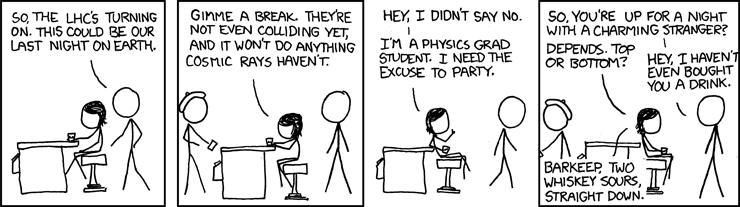
Obligitory Post on LHC First Beam

So, they got some protons go to both ways around the LHC ring. Only 14 years in the making, at the cost of canceling of the SSC and ending U.S. leadership in particle physics. That plus a little over $4 billion, with about $500 million coming from the U.S. Am I bitter? Do I regret having to fly to Geneva to work on an experiment, instead driving four hours west to take shifts? What do you think?

Here is an event display from our experiment, ATLAS, showing beam going through the detector:


Nature has a series of excellent news stories on the LHC :
LHC by the numbers : Nature News
Physicists flock to Geneva : Nature News
Particle physics: The race to break the standard model : Nature News

the last of which talks about other ways that are being used to probe the limits of the Standard Model, incudling the ongoing experiments at the Tevatron, neutrino experiments, and cosmological tests. (Gotta love the superhero pics that go along with the article!)

Black hole or stranglet production won't start until collisions begin, probably around the time of the presidential election. Rapture ready fundamentalists can make of that what they will.

Lastly, the great web comic xkcd:

Saturday, August 30, 2008

Day 1, Year 4 A.K.

The semi-anonymous British graffiti artist Banksy has made some art in New Orleans, much of it on buildings damaged by Katrina, and it is fairly awesome.

While we are at it please contribute to the Ashley Morris Fund at http://www.rememberashleymorris.com/
Ashley Morris was a scientist and activist and a fierce New Orleanian blogger post-Katrina. He passed last April.

Friday, August 29, 2008

Not the Alpha and the Omega, Just the Omega

This afternoon our experiment at Fermilab, the DZero collaboration, will announce the observation of the Omega_b baryon. This is an important discovery for DZero, the second major baryon state in as many years to be first observed by the experiment.

The discovery of the Omega itself was an important milestone on the development of particle physics, and this discovery of the related Omega_b state serves as a fitting bookend to a period of American dominance in accelerator-based particle physics. In 1964, the idea of baryons (particles like protons and neutrons) being made up of quarks was still very new and untested. The quark model proposed that year by Gell-Mann and Zweig was based on properties of particles previously observed, including a set of observation in 1962 of the Xi (related the last years discovery, the Xi_b). These observations seemed to predict a new baryon, which in the quark model would be composed of three strange type quarks, an (sss) system. It was a group at Brookhaven, led by future director Nick Samios and including Virgil Barnes, Bill Willis, and Ed Thorndike, who published the observation of a "Hyperon With Strangness Minus Three" in February, 1964, giving it the named proposed by Gell-Mann at the Rochester (now ICHEP) conference in 1962.

The Omega was the lynch pin in the establishment of the valence quark model. What followed was an intense period of research in the nature of quarks and their interactions, in which the quarks themselves became the main focus of research rather than the hunt for new meson or baryon states. The theoretical work of Feynmann, Glashow, Veltmann, Bjorken, and so many others in the later Sixties and Seventies, and the experimental observation of parton scattering at SLAC in 1969 by Friedman, Kendall, Taylor et alia, led to the development of a field theory for the quarks called Quantum Chromodynamics.It is the study of QCD and its predictions that is the main interest of our Markus Wobisch, and which is forming a key portion of our high energy physics group's analysis work at DZero and ATLAS. It is also key to the work of our medium energy particle group - Wells, Simicevic, Grimm and Johnston - as they try to understand such fundamental questions as the relative proportion of non-valence quarks such as the s-quark in protons.

Now, as we enter the twilight of accelerator-based physics in the United Sates, as our nation is preparing to no longer be the home of the highest energy collider in the world, in a beautiful act symmetry we find the cousin of the Omega, the (ssb) state known as the Omega_b, at the Fermilab Tevatron. Once again, the study of this baryon allows us the test the predictions of the quark model and the refinements possible from QCD, in the presence of the much heavier b-quark. It complements and fills in the elegant particle physics equivalent of the periodic table which is the various mesons and baryon "multiplets". But almost as importantly it forms a remarkable bookend to an unprecedented era of discovery and scientific research in this country, that proceeded in parallel with the Space Race and the breakthroughs in medicine and other fields, a time when the United Sates was the undisputed center of scientific research. We enter a new era when science well be more international and less centralized, with new nations like India and China playing an equally important role, and probably that is for the best.

But at the beginning, there was the Omega, and at the end there was the Omega_b.

Tuesday, July 22, 2008

Tiny Bubbles

Bubble Fusion Researcher Charged with Misconduct: Scientific American

This is s pretty good article on the Taleyarkhan scandal. Fortunately SciAM gets it right and identifies Taleyarkhan as an engineer, rather than as a physicist. This is what ASEE did in it's daily news digest "First Bell" yesterday, running a report from the Los Angeles Times that made the same mistake. I sent an email to the LA Times reporter who wrote the story, but no reply - hopefully mine was not the only email he received.

I can understand an engineering organization like ASEE not wanting to identify this guy as an engineer. And I do not want to pretend that improper professional behavior has not happened in physics. We recall the famous cases of recent years, the fraudulent claim of discovery of element 118 (which was later legitimately discovered) and the Schon case at Bell Labs. These two cases caused the APS to go into full frantic mode and pushing professional education in physics curriculum and a number of other remedies.

But there are some differences here. In the Ninov case (element 118) there was every reason to believe that the result was plausible - indeed the element was eventually seen, including by some of the researchers who had worked with Ninov. The Schon results, although remarkable, seemed plausible as well. It took a young professor named Lydia Sohn to carefully compare papers and to document that the same plots were being reused with different labels (she gave a talk about this at the 2004 Sigma Pi Sigma Congress).

This case smelled bad from the beginning. Most physicists hearing about sonoluminescence-produced fusion were immediately skeptical. It was too far out and seemed to violate Sagan's Razor: Extraordinary Claims Require Extraordinary Proof. My guess is that Science would never have published it, except for the claim of confirmation from other groups, confirmation which we now know did not happen and which Purdue cited has scientific misconduct in their review.

Although I should probably not raise this question in this context, I have to wonder: Do engineers approach research differently than scientists? Do the two professions, while using the same language of experimentation and similar methodologies, place different weights on what passes for verification and confirmation? I know an engineering professor, a very good guy who I will not name, who seems to be only interested in proof of principle: If he gets a device working once, then the project is done. Systematic studies for others - he has moved on to the next topic. Is this an individual trait, or is this behavior widespread among our research engineering cousins? As engineering students get less exposure to basic science (at a time when they really need more science) will the perception of research methodology between science and engineering (continue to?) diverge in the future?

Monday, July 21, 2008

Google is really starting to piss me off

Google Sux!

Traveling again, and Google is trying to be too clever. When I connect from a French server I get the French language Google page, even if I am LOGGED INTO iGoogle! I drive across the border to CERN, Google knows I am in Switzerland now, and everything is suddenly in German.

Let's put aside the little fact that this is the French-speaking part of Switzerland. If I am logged in, and Google knows my language preference, then just leave me the hell alone! Stop thinking that I suddenly am fluent in German just beacuse I am connected to a wireless hub near Geneva.

Sheesh!

Saturday, July 05, 2008

Independence Day Quotes

"There is danger from all men. The only maxim of a free government ought to be to trust no man living with power to endanger the public liberty."

- John Adams

“Of liberty I would say that, in the whole plenitude of its extent, it is unobstructed action according to our will. But rightful liberty is unobstructed action according to our will within limits drawn around us by the equal rights of others. I do not add 'within the limits of the law,' because law is often but the tyrant's will, and always so when it violates the right of an individual.”

- Thomas Jefferson

Now, we may hope that our leaders and our government stand up for our ideals, stand up for what's right, and there are many times in our history when that's occurred. But when our laws, when our leaders or our government are out of alignment with those ideals, then the dissent of ordinary Americans may prove to be one of the truest expressions of patriotism.

- Barack Obama

Sunday, May 04, 2008

With Apologies to Rev. Neimoller

First they came for the evolutionary biologists, and I did not say anything because I was not an evolutionary biologist.

Then they came for the atmospheric scientists, and I did not say anything because I was not an atmospheric scientist.

Then they came for the biochemists and geneticists, and I did not say anything because I was not a biochemist or geneticist.

Then they came for the cosmologists, and I did not say anything because I was not a cosmologist, though our areas of research are related.

Then they came for the particle physicists, and there was no one left to say anything intellectually honest.

Now, here is a cathedral for you - the ATLAS experiment at the LHC. Click on the picture to go to the ATLAS movie -

Wednesday, April 23, 2008

Persistence of Memory

OK, I want you to read this article: http://www.wired.com/medtech/health/magazine/16-05/ff_wozniak

It is a long article, ostensibly about Piotr Wozniak, a Polish programmer who developed a learning software program called SuperMemo. But the article contains much more than that: It talks about the history of cognitive neuropsychology, of the "spacing interval" effect in how we learn and forget, the reason cramming does not work, the reason why repetition does work, and lot more. If you are not familiar with this idea, below is the so-called "forgetting curve" from the article


A lot of the way we teach is based on a complete ignorance of some very basic psychology. Students need to see material again, and the repetition needs to come at increasing, rather than fixed intervals. And then there is this (from the discussion of the components to log term memory - retrieval strength and storage strength. Emphasis is mine) -

One of the problems is that the amount of storage strength you gain from practice is inversely correlated with the current retrieval strength. In other words, the harder you have to work to get the right answer, the more the answer is sealed in memory. Precisely those things that seem to signal we're learning well — easy performance on drills, fluency during a lesson, even the subjective feeling that we know something — are misleading when it comes to predicting whether we will remember it in the future. "The most motivated and innovative teachers, to the extent they take current performance as their guide, are going to do the wrong things," Robert Bjork says. "It's almost sinister."

Student evaluations, anyone? Anyway read the article, it is terrific.

Saturday, April 05, 2008

Spring

It has been spring in Louisiana for a good two weeks now. Around here the dogwoods are in bloom, bright splashes of impressionistic white dots in the emerging green of the woods. Great shoals of azaleas make their brief appearance. Redbuds have bloomed purple in the midst of oaks and sweet gums; the black gum in my backyard is tardy as always, the last tree to put out its leaves and the last to let them go.

Over Easter we made of our favorites trips, riding along the Tammany Trace "rail to trail" bike path. We parked on the middle of Abita Springs, one of the prettiest towns in Louisiana and home of a truly great brewery, and rode our bikes from Abita Springs to Mandeville on the north shore of Lake Ponchartrain, and then over to Fontainebleau State Park. Jst as we were leaving we saw this Barred Owl just a few feet off the trail:


I love Fontainebleau - gorgeous ancient oaks that you cannot wrap your arms around, tired old limbs reaching down and growing into the ground. I was very afraid that they had been damaged by Hurricane Katrina, but those fears were misplaced. These old wonders have seen at least four or five Hundred Year Storms, and they'll see a few more. Only one of the great oaks seemed in bad shape, and I think it was sick the last time we were down.


The next day, Easter Sunday, we went down to New Orleans, touring the Aquarium of the Americas and the National World War II Museum. Both are open and in great shape. The WW II museum is always a very emotional experience for me, and it was the first time Carol and Ben had toured it. Afterwards we all felt drained, and decided to come back home that night.