Saturday, July 18, 2009
And that is the way it was...
I was a six year old kid, forty years ago this week, glued to a black and white television set as Armstrong, Aldrin, and Collins headed to their rendezvous with the Moon and history. They were my heroes, the Apollo astronauts, I knew every experimental payload they would leave on the moon, every excursion that was planned, the pitch/roll/yaw of the spacecraft, the alphabet soup of NASA acronyms.
We only got two channels back then, and we almost exclusively watched the CBS affiliate. CBS news carried live coverage of the flight, narrated by two historic figures in their own right, both coincidentally named Walter: One was astronaut Wally Schirra, the only astronaut to fly in the Mercury, Gemini, and Apollo programs. The other was Walter Cronkite. Cronkite was a towering figure - journalist, war correspondent, Morrow Boy, host of television programs like "You Are There", and the greatest news anchor in television history. His was voiced we listened to every night through the turbulence of the Sixties and Seventies, his soft Missouri accent carrying both authority and reassurance.
Good night, Walter Cronkite.


Friday, July 10, 2009
A Gap in Appreciation, or Understanding ?
From this morning's "First Bell" email, a daily news round-up of science and engineering sent out by ASEE:
Survey Shows Gaps Between American Public, Scientific Community.
The AP (7/10, Schmid) reports, "The share of Americans who see science as the nation's greatest achievement is down sharply, even as the public continues to hold scientists in high regard," according to a recent Pew Research Center poll, which "indicates that 27 percent of Americans say the nation's greatest achievements are in science, medicine and technology, more than any category other than don't know." However, that figure is "down from 47 percent in a similar study a decade ago." Still, the poll found that, "overall...science remains well thought of by Americans, with 84 percent of respondents saying it has a mostly positive effect on society," even in cases "when they disagreed with some findings."
The New York Times (7/10, A16, Dean) reports, "On the whole, scientists believe American research leads the world. But only 17 percent of the public agrees." Additionally, "while almost all of the scientists surveyed accept that human beings evolved by natural processes and that human activity, chiefly the burning of fossil fuels, is causing global warming, general public is far less sure." Specifically, "almost a third of ordinary Americans say human beings have existed in their current form since the beginning of time, a view held by only 2 percent of the scientists." Regarding climate change, "about half of the public agrees that people are behind climate change, and 11 percent does not believe there is any warming at all." A large proportion of "science association members surveyed said public ignorance of science was a major problem," and classified "coverage of science by newspapers and television" as "fair" or "poor."
USA Today (7/10, Vergano) reported that, regarding animal research, "52% of the public and 93% of scientists support drug testing or other experiments on animals." And, "51% of the public and 70% of scientists support nuclear power development." Science author Chris Mooney said the results were not "hugely surprising," but were "hugely important in telling people in science that maybe they need to reach out to the public better." Alan Leshner of the American Association for the Advancement of Science (AAAS) made similar comments, saying, "The results tell us we have a lot of work to do, not only on getting the word out about scientific findings, but about how science works."
The Christian Science Monitor (7/10, Spotts) reports, "Organizations like the AAAS are trying to encourage scientists to do a better job of communicating what they do to the general public," and frequently "focus on what the public and educators need to do to boost scientific literacy." However, Mooney argues that "people form their political positions based on a variety of factors, and scientists don't know how or don't try to reach out to them." He advocates greater "personal contact," which "may not change an individual's worldview...but it does have the potential to demystify scientists and the way they approach their world."
In the msnbc.com (7/9) Cosmic Log, Alan Boyle wrote that the poll's results "show that the situation is more complex" than a divide between two groups. For example, "the Pew study points out that most Americans really like science and think it's deserving of support."
Thursday, July 02, 2009
What Skepticism Reveals about Science: Scientific American

I love this quote they use from Leonard Nimoy on an episode of The Simpsons: “The following tale of alien encounters is true. And by true, I mean false. It’s all lies. But they’re entertaining lies, and in the end isn’t that the real truth? The answer is no.”

What Skepticism Reveals about Science: Scientific American
Confronting Scientific Climate Change Deniers
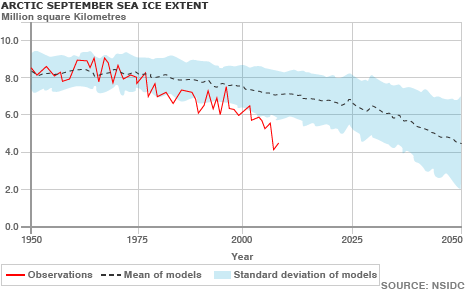
It is easy for those of us in the sciences to dismiss climate change deniers as simply uneducated or scientifically illiterate. But what about the occasional scientist, like Freeman Dyson, who comes along and challenges evidence for global warming?
I am not expert in these areas and so it is hard for me to evaluate the criticisms competently. This article on the RealClimate
does so very nicely, showing the data and graphs that are being critcized and answering those criticisms in a scientific fashion. This is a good site for climate change information.
The sad fact is that we need to confront the changes to the environment, both natural and man-made, but instead we bicker and squabble. Calling the members of Congress who voted for the recent energy bill "Cap and Traitors" is typical of this very unhelpful attitude.
Wednesday, July 01, 2009
The Future Map of South Louisiana?
In an excellent article on National Geographic's website, LSU scientist Michael Blum describes his predictions for coastal erosion between now and the end of the century: Mississippi River Delta to "Drown" by 2100?
The results is not pretty. Here is a projected map compared to today's coastline. It is not just New Orleans that is effected, Mandeville and the north shore, La Place, Donaldsonville, Houma - all gone.

The results is not pretty. Here is a projected map compared to today's coastline. It is not just New Orleans that is effected, Mandeville and the north shore, La Place, Donaldsonville, Houma - all gone.

Wednesday, June 24, 2009
Possibly the greatest ad of all time
This is the sort of thing Sigmund Freud would have come up with after a six martini lunch, if he worked on Madison Ave. in the Sixties.
BKsevenincher.jpg (image)
BKsevenincher.jpg (image)
Tuesday, June 23, 2009
Quotes
Here are a couple of quotes that seem to sum up why the LHC is taking so long to turn on:
I have yet to see any problem, however complicated, which, when you looked at it in the right way, did not become still more complicated.
- Poul Anderson (1926 - 2001)
The major difference between a thing that might go wrong and a thing that cannot possibly go wrong is that when a thing that cannot possibly go wrong goes wrong it usually turns out to be impossible to get at or repair.
- Douglas Adams (1952 - 2001), Mostly Harmless
I have yet to see any problem, however complicated, which, when you looked at it in the right way, did not become still more complicated.
- Poul Anderson (1926 - 2001)
The major difference between a thing that might go wrong and a thing that cannot possibly go wrong is that when a thing that cannot possibly go wrong goes wrong it usually turns out to be impossible to get at or repair.
- Douglas Adams (1952 - 2001), Mostly Harmless
Sunday, May 10, 2009

Monday, April 20, 2009
What’s Wrong with Education
A Textbook Example of What’s Wrong with Education | Edutopia
If you want to understand a lot of why the American educational system is so bad (along with parental indifference) then you read this.
If you want to understand a lot of why the American educational system is so bad (along with parental indifference) then you read this.
Sunday, April 12, 2009
The Last Outlaw Poet : Rolling Stone
The Last Outlaw Poet : Rolling Stone
When I grow up, I want to be Kris M.F. Kristofferson. I always have, I always will.
When I grow up, I want to be Kris M.F. Kristofferson. I always have, I always will.
Thursday, April 09, 2009
Monday, February 09, 2009
Marigot
What is the French word for a backwater? You might think "bayou" but you would be wrong. It is "marigot". And here is a interesting sentence from the French Wikipedia article:"Le terme 'marigot' est parfois employé métaphoriquement pour suggérer des activités plus ou moins occultes, en eaux troubles."
Purity
How cool is YouTube? Here is Nancy Griffiths and the greatest collections of Texas songwriters ever assembled, doing Guy Clark's great ballad "Desperados Waiting for a Train"
This is a song I will never be able to sing. Nancy Griffith sort butchers the best line:"To me he's one of the heroes of this country..."
(I miss you everyday, H.L.)
This is a song I will never be able to sing. Nancy Griffith sort butchers the best line:"To me he's one of the heroes of this country..."
(I miss you everyday, H.L.)
Wednesday, January 28, 2009
Wednesday, January 21, 2009


Sunday, January 18, 2009
We are one

Johnny was there.
Ray was there.
Marvin and Mahalia and Odetta were there.
Woody was there.
You couldn't see them, but they were there.
I heard them.
Monday, January 12, 2009
Clarence B. Jones: The 80th Birthday of Dr. King and the Inauguration of Obama as President
I found this article on the Huffington Post very affecting. It is written by one of the speechwriters for Martin Luther King, Jr., and it gives his perspective on Barack Obama's election and the 80th birthday of Dr. King.
Much is made by some of the old Civil Right movement activists, and how Obama represents a new generation, and new style, of black leadership. Jones's gives his opinion of how Dr. King might have viewed the Obama election, with a lot of interesting insights and perspectives on King and his legacy.
Much is made by some of the old Civil Right movement activists, and how Obama represents a new generation, and new style, of black leadership. Jones's gives his opinion of how Dr. King might have viewed the Obama election, with a lot of interesting insights and perspectives on King and his legacy.
Most Loathsome People of 2008
They're back! The annual list of the most loathsome people of the past year, courtesy of the Buffalo Beast. The list is at http://buffalobeast.com/134/50mostloathsome2008.html
I think last year's list was little better, but this one is still pretty good. How bad was 2008? George Bush only came in at #4, and Dick "Dick" Cheney is only the 7th most loathsome person of the year. Don't worry - you're on it, too.
I think last year's list was little better, but this one is still pretty good. How bad was 2008? George Bush only came in at #4, and Dick "Dick" Cheney is only the 7th most loathsome person of the year. Don't worry - you're on it, too.
Friday, January 09, 2009
The Best Physics Department You Never Heard Of
This week, Louisiana Tech started back in session. The first several stories on the university webpage have been dominated about news about our Physics Program. And we are still putting together a press release about Tabbetha Dobbins getting a CAREER grant!
Thursday, December 18, 2008
Wednesday, January 07, 2009
Friday, January 09, 2009
Thursday, December 18, 2008
Tech researchers and Italian National Nanotechnology Laboratory scientists recognized for collaboration - jroberts
Louisiana Tech and the Italian National Nanotechnology Laboratory’s joint project, “Nano-carriers for Cancer Therapy” has been selected among the 20 most important scientific projects for Italy-USA Collaboration by the Progetto Bilaterale Italia-USA. The collaboration was led by Dr. Yuri Lvov, a professor of micro and nanosystems at Tech’s Institute for Micromanufacturing, and Stefano Leporatti of the NNL.
The primary purpose of the collaboration was to develop new nano-carriers and to study their uptake in cells for development of new cancer therapies. The current project is based on NNL’s research on advanced optical and scanning probe facilities and Tech’s expertise in developing advanced nano-carriers for cancer drug delivery developed at the IfM benefited the work.
In addition to the medical applications, the project will be useful in the multi-disciplinary training of graduate students in the bio/nano technology environment.
Also, Leporatti and doctoral student Viviana Vergaro of the Italian National Nanotechnology Institute recently visited the IfM, when Leporatti delivered the lecture, “Engineering Micro/Nano Environment via Layer-by-Layer Composite Films for Breast Cancer Cell Controlled Growth.” On that visit, Leporatti also presented a seminar on using virus arrays for templated nano-lithography.Wednesday, January 07, 2009
Louisiana Tech physicists highlight Top 10 science stories of 2008 - dguerin
Discover, one of the world's premier science and technology news magazines, released its list of the Top 100 Stories for 2008 and features two projects involving physicists from Louisiana Tech University in its Top 10.
The Large Hadron Collider (LHC) project, which involved over 5,000 scientists and engineers from 26 nations, ranked #2 on the list. Drs. Lee Sawyer, Dick Greenwood, and Markus Wobisch led a team from Louisiana Tech that is involved in the commissioning and operation of the ATLAS detector, which will allow scientists to tap into the physics potential of the LHC.
"[Tech] has three faculty members and two graduate students working on the ATLAS experiment, and our post doc at Fermilab has begun the transition to LHC-related work," says Sawyer, head of the physics department at Louisiana Tech.
The LHC accelerates two streams of protons toward each other at nearly 99.99% of the speed of light in an effort to prove, or possibly disprove, the "Big Bang Theory." It could also explain why some particles are massive while others are without mass, why there is matter and not antimatter, and whether or not other dimensions exist.
According to Sawyer, the same faculty members, along with several other undergraduate and graduate students, are also working on the D0 experiment at Fermilab. Their efforts played a significant part in the recent discovery of the Omega_b baryon.
Tech physics professor Dr. Dentcho Genov contributed to research related to technology needed to make an "invisibility cloak." Ranked #7 on the list, researchers are creating laboratory-engineered wonder materials that can conceal objects from almost anything that travels as a wave, including light, sound and, at the subatomic level, matter itself.
According to Discover, these engineered substances, known as "metamaterials," get their unusual properties from their size and shape, not their chemistry. Because of the way they are composed, they can shuffle waves away from an object.
"These metamaterials, undreamed of a few years ago, may prove to be one of the key technologies of the 21st century," explains Sawyer. "Already people are beginning to think of innovative ways of applying these materials. While a lot of discussion has been about 'cloaking devices,' there is a lot of promise in new optical devices and coatings."
In addition to the recognition by Discover, Time magazine also acknowledges the significance of these two projects, ranking the LHC story at #1 on its Top 10 of 2008 list and the "invisibility cloak" story at #7.
"This recognition by Discover and Time magazines confirms that the physics faculty at Louisiana Tech are contributing significantly to relevant and vital science discoveries," says Dr. Stan Napper, dean of Louisiana Tech's College of Engineering and Science. "Our students are directly benefiting from these outstanding researchers who are also outstanding educators."
"Person for person, we have the finest physics faculty in the country," adds Sawyer. "Our faculty offer students at both the undergraduate and graduate level a wide range of opportunities for research at the forefront of science."Friday, January 09, 2009
Inspection technology by Louisiana Tech researchers to examine underground infrastructure - dguerin
An innovative underground scanning technology developed by Louisiana Tech researchers is the cornerstone of a technology development and commercialization project that has secured one of only nine Technology Innovation Program (TIP) grants awarded nationally by the National Institute of Standards and Technology (NIST).
"$3.2 million has been secured for this project, of which nearly $900,000 will flow to Louisiana Tech over the next three years," says Dr. Erez Allouche, associate professor of civil engineering and associate director of Louisiana Tech’s Trenchless Technology Center.
Allouche, along with Drs. Arun Jaganathan, Neven Simicevic and Klaus Grimm, is partnering with Elxsi Corporation of Orlando to develop a deep-penetrating scanning system, based on a new technology called ultrawideband (UWB) pulsed radar. This technology will allow for the inspection of buried pipelines, tunnels, and culverts to detect fractures, quantify corrosion, and determine the presence of voids in the surrounding soil.
The project, called FutureScan, incorporates leading-edge simulation, electronics, robotics, signal processing, and three-dimensional (3-D) rendering technologies in a package that can be mounted on existing pipe-inspection robots.
A patent on this new technology is currently pending. This is the first attempt to commercialize UWB for the inspection of municipal pipes around the world.
Using highly directional electromagnetic pulses and special signal-processing algorithms derived from mine and bomb detection technology, the technique can "see" through solid objects and measure both surface and internal structural integrity.
"Our project will greatly increase the ability of municipalities and DOTs to detect developing sink holes around buried pipes before they propagate to the surface and cause collapse of the roadway," explains Allouche.
The consequences of pipeline failure range from disease-causing water pollution to sometimes fatal highway accidents. The United States has over one million miles of buried pipes carrying water to cities, towns, and homes.
"In addition to the federal funding [Louisiana Tech] receives, this award will also mean the establishment of new technical positions, the creation of a new start-up company in Tech's incubator, and the potential for a leading-edge technology, developed at Louisiana Tech, getting into markets around the world," adds Allouche.
TIP was created to support innovative, high-risk, high-reward research in areas of critical national need where there is a clear interest because of the magnitude of the problems and their importance to society.
Allouche appreciates the prestige and exclusivity that this program carries.
"The high dollar value attracts proposals from the best academic institutions in the nation. This award is another example of the growing ability of Louisiana Tech to develop innovative technologies and bring them to a market-ready status."
Subscribe to:
Posts (Atom)